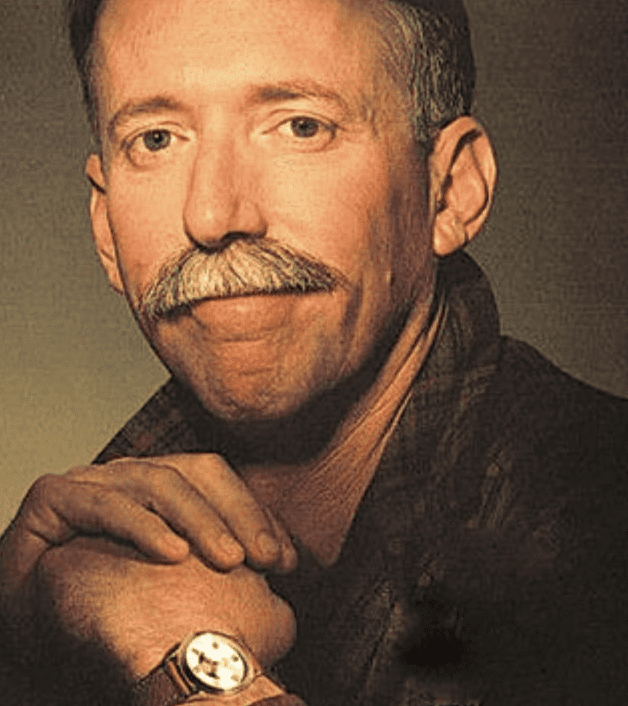

Lawrence Richard Walters, known as “Larry,” dreamed of flying since he was a child. His fascination with the sky began at age 13 when he first saw helium balloons in a store. Although Walters couldn’t become a pilot in the U.S. Air Force due to poor eyesight, he refused to give up on his dream and decided to conquer the sky in another way. His story became legendary and is forever etched in aviation history as an example of boundless courage and creativity. More at i-los-angeles.
The Adventure Begins
From a young age, Larry Walters dreamed of flying. But life had other plans: poor eyesight disqualified him from becoming a U.S. Air Force pilot. This rejection didn’t break him; instead, it became a challenge. For many years, Walters studied the physics of flight, calculated the lifting power of balloons, and eventually developed his own project: a flight in an ordinary lawn chair.
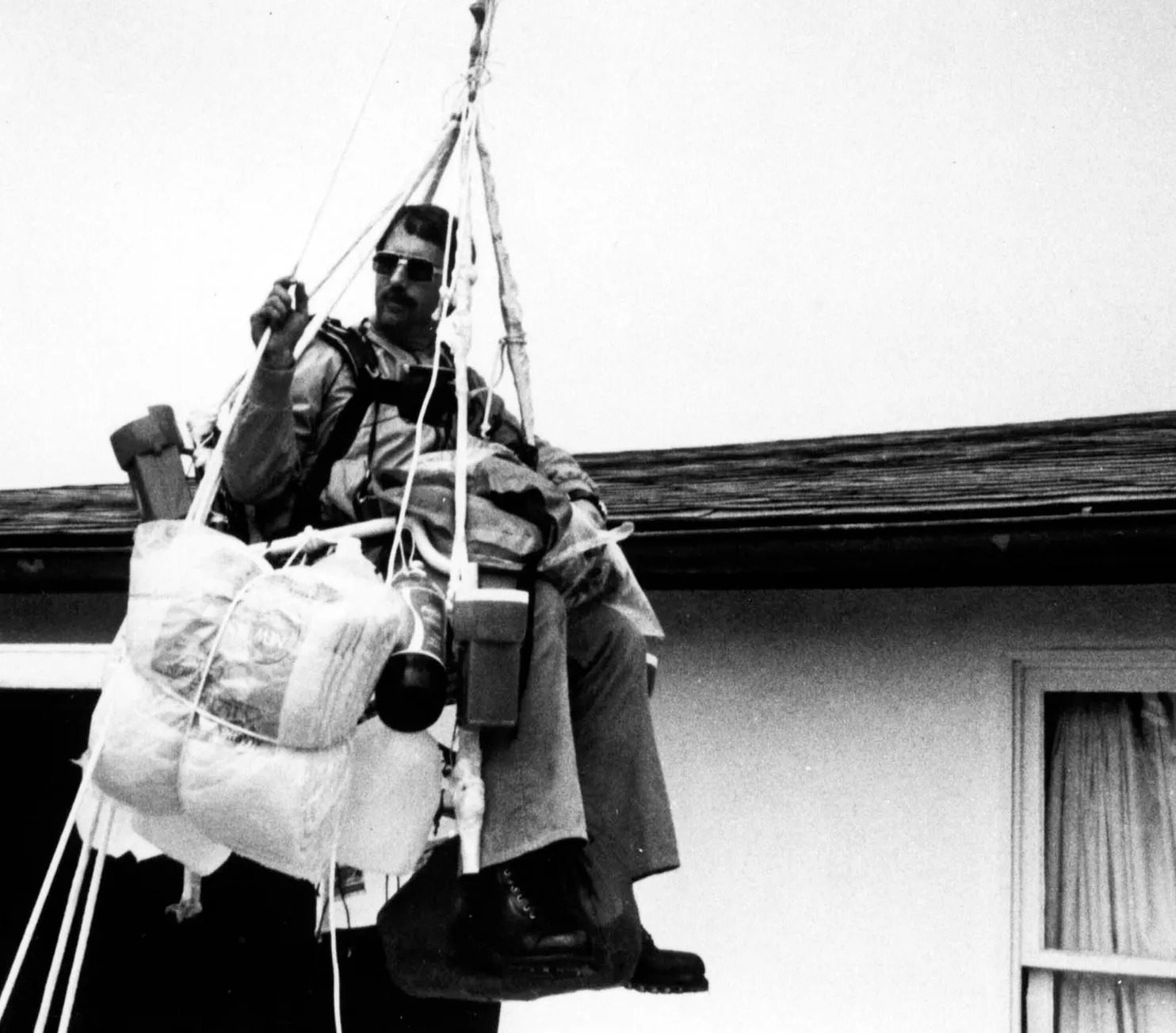
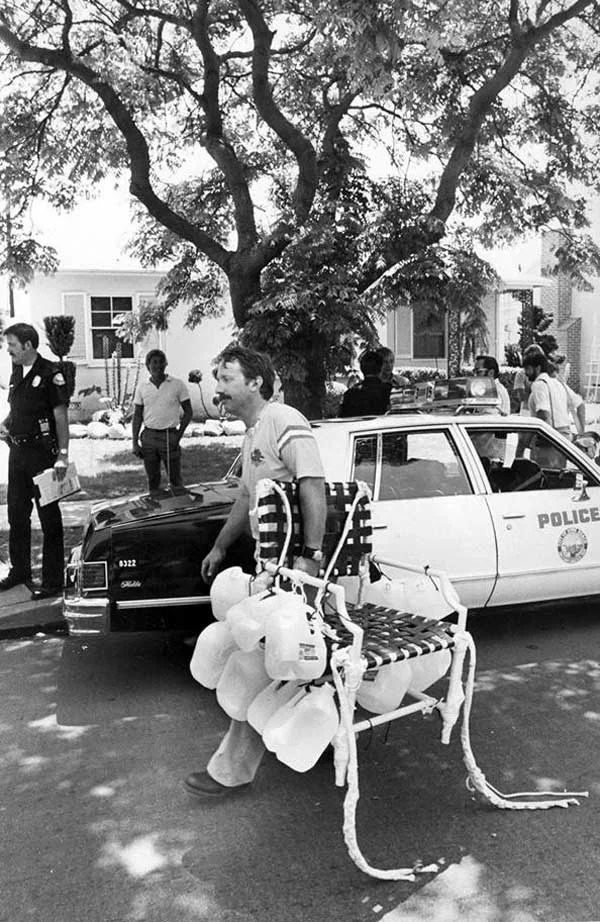
In 1982, Walters decided to bring his long-held idea to life: ascending into the air using ordinary helium balloons. He planned to gently float over the Mojave Desert and descend by shooting the balloons with a pellet gun. To do this, he and his girlfriend, Carol Van Deusen, bought 45 balloons and tanks of helium. To make the purchase seem legitimate, Walters used a forged document from his employer, FilmFair Studios, stating the balloons were for a television commercial. For ballast, he brought 13 plastic jugs of water. He bought the lawn chair for $109. Walters also packed a parachute, a CB radio, sandwiches, two liters of Coca-Cola, a six-pack of beer, and a camera, although, as it turned out, he didn’t take a single photo during the flight.
Preparation and Flight
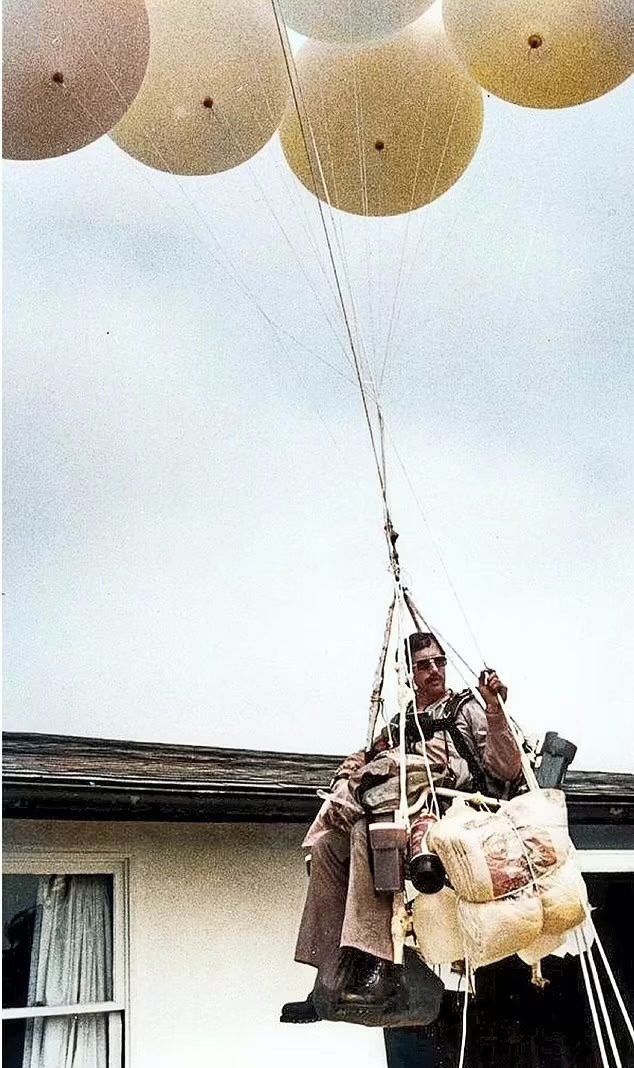
On July 2, 1982, Walters tethered 42 balloons to the chair in the backyard of Carol’s mother’s house in San Pedro. When the tethering rope snapped prematurely, he unexpectedly shot up to an altitude of about 16,000 feet. He was spotted by two commercial airline pilots, and Walters maintained contact with a group called REACT via his radio, explaining that it was an unauthorized launch but that he was safe.
After 45 minutes in the air, Walters began carefully shooting the balloons to descend. He accidentally dropped his pellet gun, and his chair drifted into power lines in Long Beach. This caused a 20-minute power outage. Fortunately, Walters landed unharmed.
The Aftermath
After landing, Walters was immediately arrested by the Long Beach police. He faced penalties for violating federal aviation regulations. Initially, Walters was fined $4,000, but the fine was later reduced to $1,500. Some charges were dropped because they did not apply to his “class of aircraft.”
After his flight, Larry became a media sensation. Newspapers dubbed him “Lawnchair Larry,” “the aerial dreamer,” and some simply “crazy.” Walters himself insisted his actions were not impulsive but carefully calculated. For many, he became a symbol of someone unafraid to look ridiculous to achieve his dream. It was this image that inspired British composer Jack Godfrey to create the musical “42 Balloons,” which premiered in 2024 at The Lowry theatre in Greater Manchester. When “42 Balloons” first opened in the UK, audiences reportedly left in tears. Beneath the laughter and absurdity of the story, they felt its core message of sincerity and humanity.
Walters later confessed that he made the flight because he had dreamed about it for twenty years; otherwise, he believed, he would have gone crazy. His chair was nicknamed Inspiration I, and Walters was given the title “At-Risk Survivor” in 1993 by the Darwin Awards. Ten days after his flight, he appeared on “Late Night with David Letterman” and briefly became a popular motivational speaker. The chair was later displayed at the San Diego Air and Space Museum and subsequently donated to the Smithsonian National Air and Space Museum in Washington, D.C., where it remains part of an exhibit showcasing the ingenuity and courage of an ordinary person.
After the flight, Walters volunteered in the San Gabriel Mountains and worked for the U.S. Forest Service. His personal life was difficult, marked by a breakup with his girlfriend of 15 years and unsteady work as a security guard. On October 6, 1993, at the age of 44, Walters committed suicide in the Angeles National Forest.
Other Helium Balloon Flights
Larry Walters became a part of American folklore, a kind of folk hero alongside others who boldly defied reality. His story is used in schools and lectures on creative thinking and human persistence. After his flight, a new hobby even emerged: cluster ballooning, where people ascend into the sky on a bundle of balloons. Some enthusiasts replicated Walters’ feat, though not all returned so safely. In 1984, Kevin Walsh flew on 57 balloons in Massachusetts. In 2007, Kent Couch made a 240-mile interstate journey on 105 balloons. In Brazil, the priest Adelir Antônio de Carli ascended on 600–1,000 helium balloons, reaching 6,100 meters, but died during one of his flights. American explorer Jonathan Trappe, Canadian adventurer Daniel Boria, Tom Morgan from England, and illusionist David Blaine have all continued to experiment with cluster ballooning and set new records.
When the Pixar movie “Up” was released in 2009, many recognized an allusion to Walters’ story. The aerial journey of the elderly Carl Fredricksen captures the same spirit of freedom, loneliness, and determination that once pushed Larry to fly.
His story became a symbol of human courage and the pursuit of a dream, despite the risks and limitations. Walters proved that even an ordinary person with a lawn chair could conquer the sky and leave a mark on culture and aviation history.