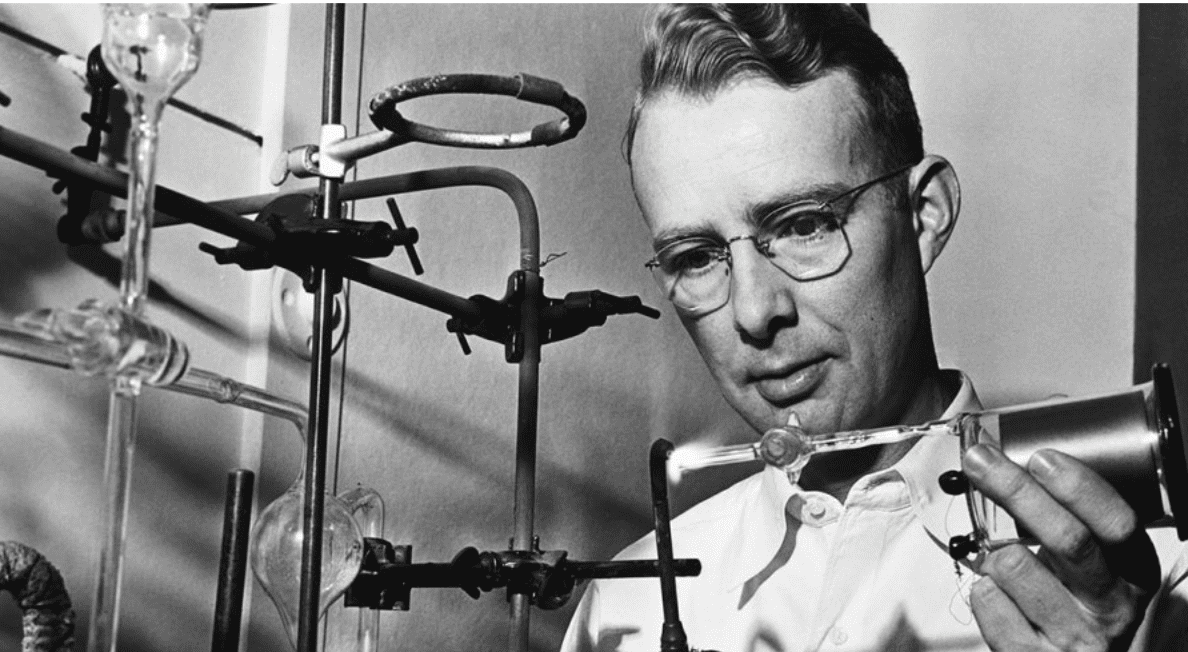
Luis Alvarez stands out as one of the most renowned experimental physicists of the 20th century. He seamlessly blended the roles of scientist, inventor, detective and researcher. Alvarez played a pivotal role in advancing nuclear physics, particle accelerators, detectors, and large-scale data analysis. He not only pursued his own projects but also fostered an environment that inspired others to think big and aim high. Additionally, discover the story of Jerome Lemelson, the king of patents and how he built his wealth through inventive ideas. Stay tuned for more on i-los-angeles.
Biography
Luis Walter Alvarez was born in San Francisco in 1911. At the age of 14, his family moved to Rochester, where he found the science classes at Rochester High School to be rather uninspiring. Unlike his classmates, who used pencils and erasers for corrections, Luis preferred to do his math calculations with a fountain pen, even during exams. His passion for physics sparked after he attended a lecture on ophthalmic optics at the Mayo Clinic. Recognizing his newfound enthusiasm, his father introduced him to a variety of annotated physics books from their home library. During his teenage years, Luis worked at the instrument shop of the Mayo Clinic during the summer. This opportunity enabled him to develop crucial skills, including gear cutting, circuit wiring and mastering various trade techniques. These skills would later prove beneficial in his endeavors related to nuclear weaponry, particle accelerators and other sophisticated devices and instruments.
After finishing high school, he went on to study at the University of Chicago. However, after graduation, he returned to Rochester and the Mayo Clinic to seek treatment. He was diagnosed with biliary lithiasis and the doctors recommended gallbladder surgery. Louis spent the entire summer of 1941 in Rochester recovering from the procedure, but he made the most of his time there. Leveraging his expertise as a physicist and collaborating with a physician at the Mayo Clinic, he created a more advanced technique for the radiographic detection of gallstones, utilizing the critical absorption method he had previously applied to identify K-electron capture.


Scientific contributions
Before World War II, he concentrated on innovative discoveries such as cosmic ray charge, neutron magnetic moment, electron capture by nuclei and tritium radioactivity. In the years after the war, Alvarez developed several groundbreaking inventions, including the proton linear accelerator and the Van de Graaff tandem accelerator. Over his career, he received over 40 patents in the United States. Several significant patents feature the Ground Controlled Approach, the Microwave Early Warning System, the Materials Testing Accelerator, the Alvarez Linear Accelerator and a variety of innovative optical devices. He was one of the inaugural inductees into the Inventors Hall of Fame.
One evening, Luise caught a news report about some cracks discovered in the newly finished Alaska pipeline. This led him to think about possible solutions to the problem. By the following day, he had come up with a device designed to navigate through the pipeline and detect the cracks automatically. Most of his ideas, unfortunately, never saw the light of day. About ninety percent of them lacked practical application. Still, the scientist remained undaunted. He was convinced that one should strive to create results that were not only effective but also beneficial.

Alvarez’s group
The idea for a new project originated from a discussion with Don Glaser, the inventor of the bubble chamber. Alvarez was convinced that a sizable liquid hydrogen bubble chamber was essential to unravel the mysteries posed by numerous particles. He quickly assigned the task to his two graduate students, Lynn Stevenson and Frank Crawford, along with a few of his technicians. The initial signs in the hydrogen bubble chamber were detected during the summer of 1954. The experiment reached its peak with a 72-inch bubble chamber that started functioning in 1959.
In 1967, the Alvarez team was processing over a million events annually. A dedicated team of scanners meticulously reviewed the films for significant occurrences while numerous computer programmers developed software for analysis. At that time, the bubble chamber team was the largest high-energy physics group globally, consisting of several hundred members. The advancements in the chamber and analysis systems led to a surge of new particle discoveries, which played a crucial role in establishing the quark model. This groundbreaking work earned Alvarez the Nobel Prize in Physics in 1968. He was honored for his significant contributions to elementary particle physics, particularly for uncovering numerous resonance states, a feat made possible by his innovative use of a hydrogen bubble chamber and meticulous data analysis.
His achievements also include the discovery of K-electron absorption, the observation of tritium, the construction of the first proton linear accelerator and various other groundbreaking efforts in particle physics at the University of California, Berkeley.

Hypothesis on the causes of dinosaur extinction
In the later years of his life, Alvarez became deeply interested in geology. His son, Walter Alvarez, a geologist who had studied the Cretaceous-Tertiary boundary in Italy, gifted him a rock that illustrated the clay boundary. This boundary divides a layer of limestone rich in fossils from various species and a layer that shows little evidence of life. Louis found this fascinating and eventually devised a method to figure out how long it took for the clay layer to form. This would indicate whether the mass extinction occurred suddenly or over an extended timeframe.
For many years, the reason behind the simultaneous deaths of numerous inhabitants of the planet remained a mystery. In fact, the only hypothesis that existed at the time was climate change resulting in an ice age. However, climate changes are not sudden like weather changes. In 1980, Nobel Prize winner Luis Alvarez and his colleagues suggested that 65 million years ago, a 10-kilometer asteroid struck Earth, resulting in the mass extinction of numerous species, including the dinosaurs.
Two decades after the hypothesis was put forward, the Chicxulub crater was found in the Gulf of Mexico, close to the Yucatan Peninsula. This crater perfectly matches the age and size of the asteroid. It has a diameter of about 180 kilometers and extends both into the Gulf and onto the land.

There are three key pieces of evidence supporting the idea that the Chicxulub crater was formed by the impact of a cosmic object:
- A thin clay layer that delineates the boundary between different geological periods.
- An unusual concentration of the rare element iridium found within this layer.
- The presence of quartz and tectonic glass particles, which are formed under extreme conditions.
Neutron activation analysis revealed an unexpected amount of iridium in the clay layer. This finding contributed to Alvarez’s theory that a comet or asteroid impact led to the extinction of dinosaurs and other species. The announcement stirred up controversy, which was only resolved in favor of this theory in the 21st century.
Luis and his son, Walter, were bestowed with a remarkable honor, a distinction that is quite rare for scientists during their lifetimes. The International Astronomical Union, following the suggestion of Dr. Eugene Shoemaker, the discoverer of a new asteroid, decided to name it Asteroid Alvarez. This naming serves as a tribute to Luis and recognizes the collaborative work of the father-son team, Luis and Walter. The distinguished scientist passed away from esophageal cancer on September 1, 1988, in Berkeley, California.