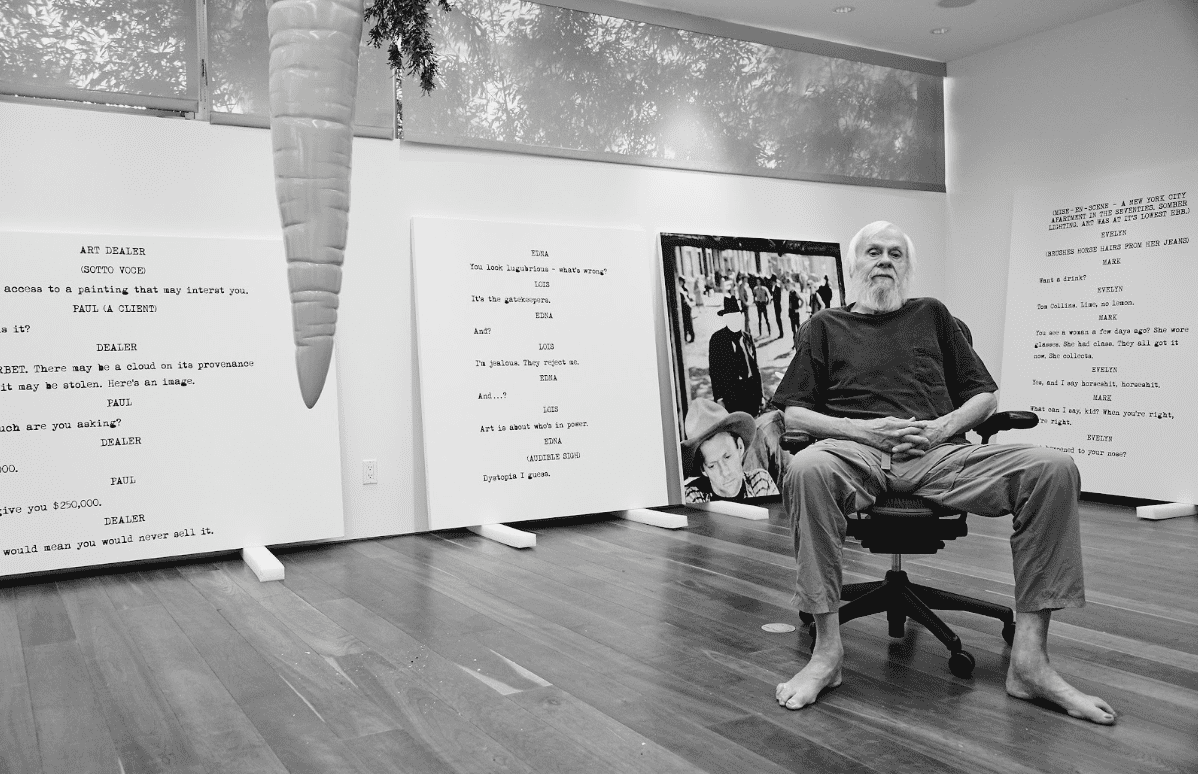
He is regarded as one of the pioneers of new forms of art. Without his ideas and concepts, it is difficult to imagine the American art of the 20th and 21st centuries. His creative pursuits included theatrical performances, painting cars and umbrellas and designing jewelry. His work has been displayed at over 200 solo exhibitions in the United States and Europe, as well as countless group shows. In addition to his active artistic career, he spent 30 years teaching art to students at several universities. Those included some notable artists. You may also read more about Meghan Markle, the Duchess of Sussex, who was born in Los Angeles. Learn more at i-los-angeles.
Biography
John Baldessari was born on June 17, 1931, in National City, California. He had a rich ethnic background. His mother was originally from Denmark, while his father was from Austria. However, the artist spent his childhood in Southern California. John and his sister went to Sweetwater High School and San Diego State College. At school, he was bullied because of his ethnicity and strong accent. His childhood in a small town shaped his worldview and formation as an artist. He did not have the opportunity to visit big museums and view real works by great artists. For the most part, he saw art through reproductions. After college in San Diego, he attended the University of California, Berkeley. He also studied at Otis Art Institute and the Chouinard Art Institute in Los Angeles. At the age of 29, John married Carol Ann Wixom. She worked as a teacher. The marriage lasted 24 years, and the couple had two children.
In 2020, the artist passed away. The artist became a classic many decades ago, but he continued to seek new meanings and engage in purposeful artistic actions-provocations until his final days. In the art world, he was regarded as a “prophet” of conceptualism, whose main instrument was language.

Creative work
At the start of his creative career, the artist was drawn to abstract expressionism. As a student, he frequently painted from life. In the mid-1960s, Baldessari came up with the notion of incorporating text fragments and photographs into his works. This collection is referred to as “phototext canvas”. Baldessari’s first solo exhibition debuted in 1968 at the Molly Barnes Gallery in Los Angeles. The works brought attention to the figure of Baldessari. Following the exhibition, he gave an interview to the influential Artforum magazine.
In July 1970, the artist made the final decision to give up painting for good, and he celebrated this event in an extravagant way. He collected his early works, broke the frames, performed an impromptu funeral dance on canvases and sent the remains of the paintings to the crematorium. The ceremony did not end there, the following morning, an actual obituary about the deceased art was published in the local newspaper. Furthermore, he used the ashes that remained after burning to make the next art piece. It was a book-shaped funeral urn. He then added the remaining ashes to the cookie dough. This cookie became the focal point of a separate installation. The artist placed it in a jar, which was accompanied by a bronze plate bearing the dates of birth and death for each canvas. With these performances, the artist demonstrated the connection between creative activities and the cycle of human life. During this time, he promised himself that he would not indulge in “boring art”.

In the 1970s, Baldessari’s work included photographs, prints, videos, installations and sculptures. He frequently painted using the collage technique. He made clippings from newspapers, posters and magazines. This marked a turning point in the artist’s career. He enjoyed deciphering codes on collages and producing them for viewers. The artist also created thematic collections of frames from Hollywood films. This was a kind of alphabet that made up the film language.
During this time, Baldessari actively began to pursue photography. He organized his photos into albums and put captions with recommendations under each one. He did not overlook video art either. In 1971, he published the 20-minute film “I Am Making Art”. In the video, the artist changes poses and each time exclaims: “I am making art.” With this work, he challenged conceptualist practices of simplifying and reducing art. One of the artist’s most striking video works is the work titled “Baldessari Sings LeWitt”. In this video, the artist sings theses to the camera from “Paragraphs on Conceptual Art” by Sol LeWitt, an American artist and founder of minimalism, to the camera.
In the 1980s, Baldessari rose to prominence beyond the United States. In 1981, he made his debut at the New Museum of Contemporary Art in New York. He was also known for his own comic titles of the works, such as “Eggs and Sausage” and “Ingres”, among others. One of John Baldessari’s works, a piece called “Quality Material” has hung in salons and been kept in storage facilities for more than 40 years. Back in 2007, art critics estimated it at nearly $4 million.


Teaching activity
In addition to his creative pursuits, he worked as a teacher for more than 30 years. In 1959, Baldessari started teaching art at San Diego City College. In 1970, the artist relocated to Santa Monica, where he met many artists and writers who taught at the California Institute of the Arts in Valencia, Los Angeles. Later, Baldessari began teaching his own course at CalArts. He later transferred to the University of California, Los Angeles (UCLA). In 2008, he left his position. Baldessari engaged in teaching activities not for money but for pleasure. It was his mission.
During the creation of one of the works, Baldessari commissioned fourteen artists to paint from a series of photographs from his collection. Although the artists did the work in their own style and had their names inscribed on the canvases, this piece was credited to Baldessari. This way, he developed the concept and directed his subordinates to execute it in their own distinctive style. Baldessari believed that conceptual art was distinguished by its unique ideas.

Works of the artist in the 21st century
In 2007, the work “Quality Material” sold for $4,408,000 at Christie’s auction. In 2008, Baldessari took part in the “Artists for Obama” project. He then created a series of prints in support of the Democrats during the presidential campaign. In 2009, the Tate Gallery in London held a large-scale retrospective exhibition called “Pure Beauty”. This work addressed the eternal question: “What is beauty?” and exposed the subjectivity of the concept. Around that time, the artist received the Golden Lion Lifetime Achievement Award for his lifetime contributions to the development of art.
In 2010, a retrospective exhibition of Baldessari’s art opened in one of the most conservative museums in the United States, the Metropolitan Museum of Art in New York. In 2012, the Los Angeles County Museum of Art released a short documentary titled “A Brief History of John Baldessari”. In 2014, the fashion house Saint Lauren released a limited collection of dresses with Baldessari works printed on fabrics. The artist stated that it was a great honor for him.
Despite his influence and famous status in the world of contemporary art, Baldessari refused to identify himself as an artist. He had a lifelong passion for art and saw it as his mission.