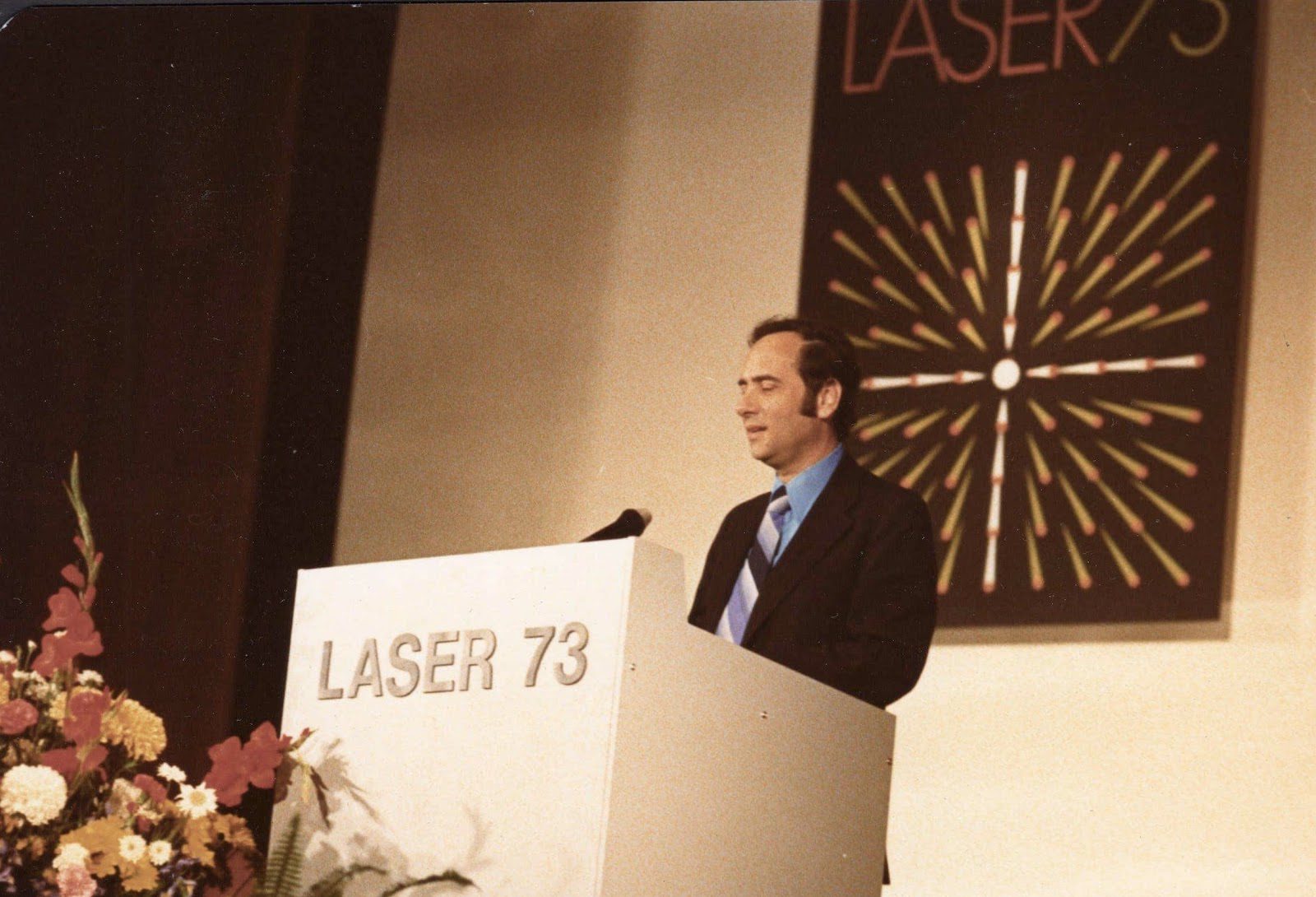

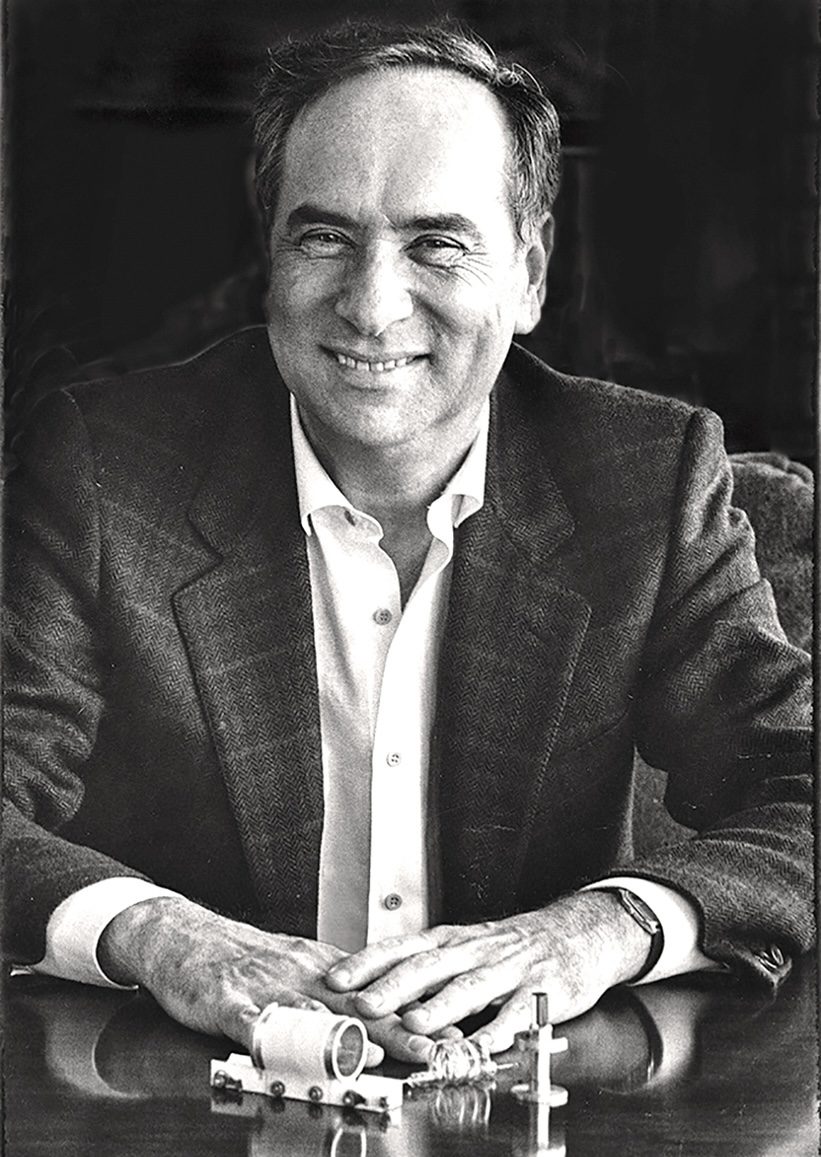
Theodore H. Maiman went down in history as the physicist who, for the first time in the world, managed to obtain a laser effect on a solid-state active element. In the laser he created, the active substance was a ruby cylindrical rod. The excitation was carried out by means of optical incandescence.
To ensure the energy levels in the ruby crystal, the lamps operated in the mode of ultra-bright short flashes. This ensured the pulsed mode of operation of the laser. Find out more about three of Elon Musk‘s famous inventions. Read more on i-los-angeles.
Biography
T. Maiman was born in LA, California. But almost immediately after his birth, his parents moved to Denver, Colorado, where his father Abe, an electrical engineer and inventor, got a job with the Mountain States Telephone Company. Abe Maiman always set up a small electronic laboratory either in the basement or in the attic of the family home. Theodore often used it to improve his technical and scientific knowledge.
With this knowledge, he got his first job in an electronics store, repairing appliances and radios. When the store owner left to serve in the army during World War II, Theodore took over the store at the age of 13. He continued working at this job in high school, earning money to save for his college education.
At the age of 17, Theodore enlisted in the U.S. Army. He was quickly accepted into the army’s radar and telecommunications training program, an experience that strengthened his knowledge of electronics. As a result, he wrote his undergraduate coursework in both engineering and physics at the University of Colorado and earned a bachelor’s degree in engineering physics. From there, he enrolled in physics courses at Stanford and was accepted into the school’s PhD program in physics.
Willis Lamb, a theoretical physicist at Stanford, took Maiman under his wing and served as his supervisor. Lamb needed the help of a researcher who understood the mathematical formulations of physical hypotheses and could turn them into experiments to prove or disprove their validity. Maiman was well suited for such a project. He quickly learned vacuum systems, methods of measuring vacuum, electrical discharges and the different types of instruments used to measure the properties of light. All of this knowledge later proved to be very important to his ability to develop strategies for laser development.
Maiman successfully defended his doctoral dissertation in 1955. Later that year, Lamb received the Nobel Prize in Physics, based in part on a laboratory proof of the Lamb shift.
In 2006, Theodore was involved in a car accident in which his car was damaged. Physically, nothing seemed to happen to him, but the trauma of the accident may have caused a rare disorder called mastocytosis. The scientist passed away on May 5, 2007, leaving an important legacy in the form of a laser that affects so many aspects of human life.
First challenges
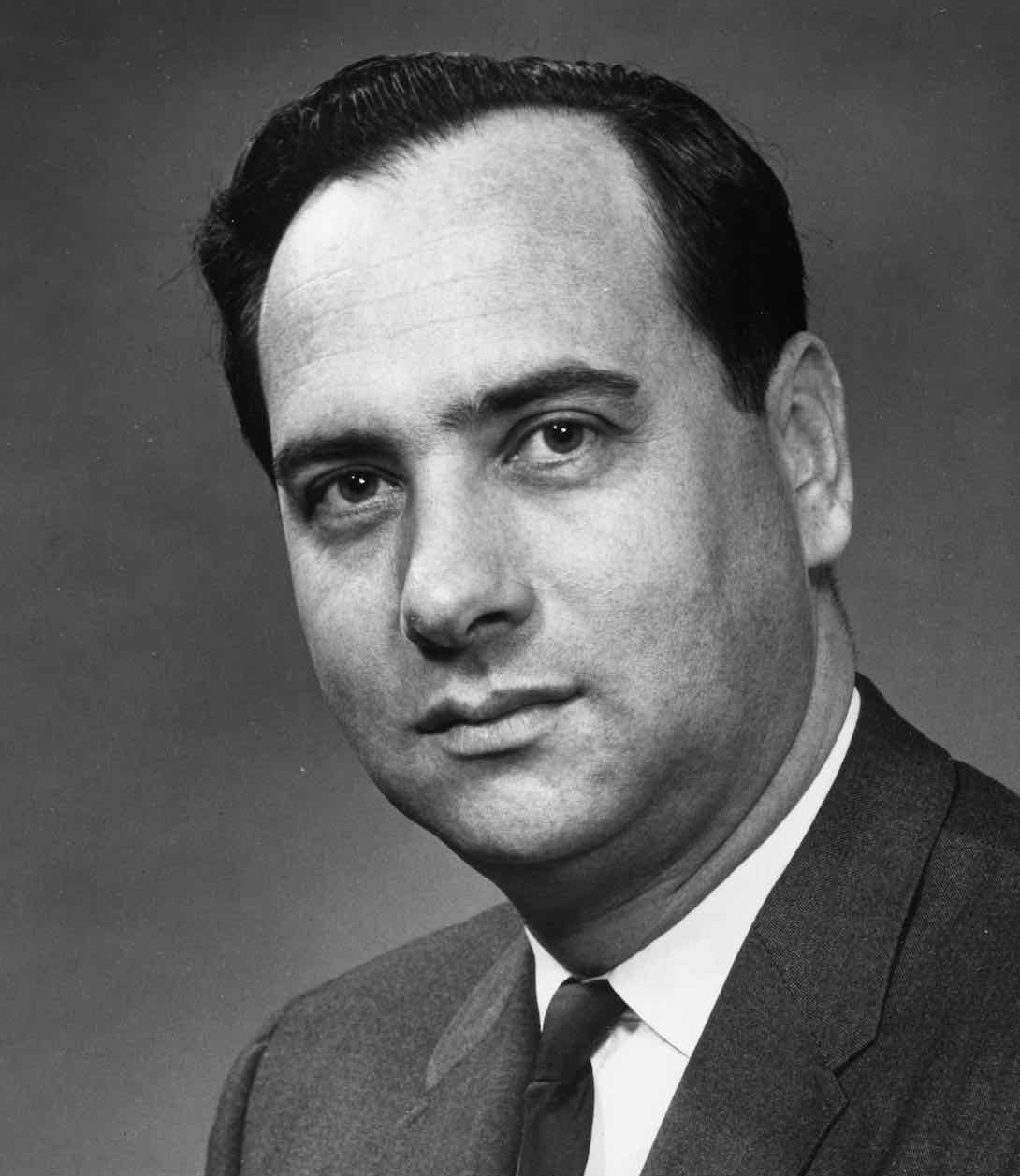
After graduation, Maiman moved to the Hughes Research Laboratories in Culver City, California, to work in the newly formed Atomic Physics Department. The U.S. Army Signal Corps contracted Hughes to build a cutting-edge microwave amplifier known as a ruby maser, and Maiman was chosen to lead the project.
The existing maser was a large device the size of a room with a very complex cryogenic cooling system and a huge electromagnet weighing almost 2,500 kilograms. Despite the fact that this device was large, heavy and very expensive, it was not very stable. Maiman’s challenge was to make it smaller, lighter, cheaper and more stable. In a relatively short time, the design of the ruby-based maser was simplified, the weight was reduced by more than 200 times and the power of the microwave was increased.
How was the laser invented?
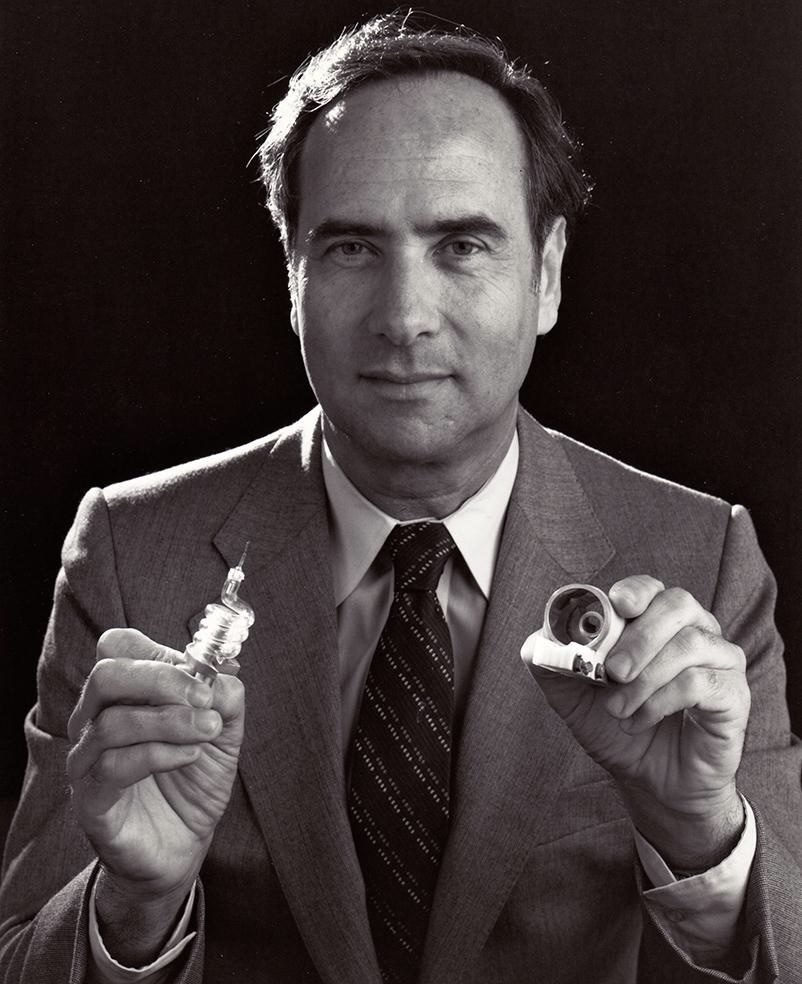
The possibility of stimulated emission was first proposed by Albert Einstein in 1917. It required an electronic “population inversion.” The latter is a counterintuitive state in which atoms are more in an excited state than in a lower energy state.
Several groups of top-notch scientists in the US and around the world provided generous funding and began their work on laser fabrication. The most active were the Columbia Radiation Laboratory (Townes), Bell Telephone Laboratories (a couple of laser teams), TRG, MIT and others.
Maiman was still finishing his ruby maser project when the laser race began. By the time he returned to his earlier ideas for the laser in August 1959, he was already eight months behind the competition. He decided to approach Hughes executives, seeking funding for the development of the laser, as such support was easy to secure. They gave him $50,000, one part-time technician and nine months to work on the laser. By contrast, competing labs had started earlier, some with budgets in the millions of dollars and large teams of researchers.
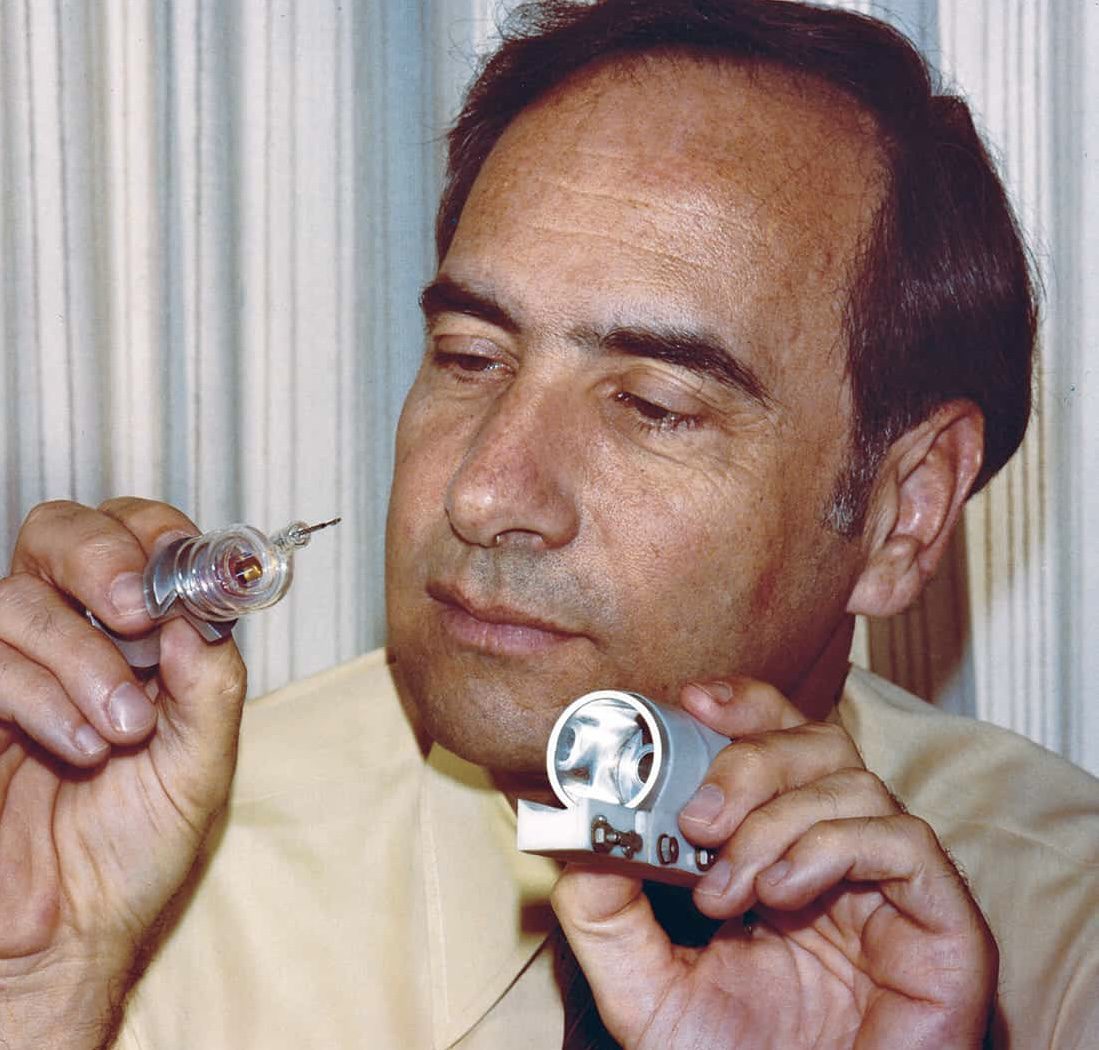
Maiman’s practical experience with the previous project dictated several points. Namely, the design should be simple, do not use cryogenic cooling and rely on readily available components and materials. Maiman was confident. The man was well aware of the optical properties of synthesized pink ruby and seriously considered it a potential laser medium.
Maiman was not discouraged by other scientists’ dismissive comments about ruby and decided to continue his approach. He redid the calculations on the properties of ruby and confirmed his previous theory. The output footprint began to increase in intensity peaks, and the initial decay time decreased rapidly. Thus, the laser was born. To confirm that this was indeed a laser action, the researchers made additional measurements of the spectral width of the emitted light.
Maiman gained access to a highly specialized, expensive high-resolution spectrograph. Using it, they were able to show that only one of the two fluorescent modes referenced in the two spectral lines could be a laser. This was what Maiman had predicted in his earlier calculations, and it was this mode that was shown in 1960.
For his contribution to science, Maiman received a number of prestigious international awards and prizes. The first was the 1966 Fannie and John Hertz Foundation Award, presented to Maiman by U.S. President Lyndon B. Johnson. In 1984, he was awarded the Wolf Prize. In 1987, he received the Japan Prize, which was presented by Konosuke Matsushita (founder of Panasonic Corp.) in the presence of Emperor Hirohito and the Prize Foundation. Maiman was nominated for the Nobel Prize three times. However, he was unsuccessful. The man had also received many honorary doctorates from prominent universities around the world.
Why did he succeed?
When Theodore designed, built and then successfully operated his original ruby laser, it took him only eight months to complete the task. He did so on a budget of $50,000. Theodore’s ability to complete engineering tasks with the simplest of designs was one of the main reasons for his success.
In addition to his deep intellect, the scientist received a remarkable combination of elements in his education. His informal education began when he experimented in his father’s laboratory and later when the man worked as an electrical appliance repairman. His formal education included both engineering and physics. Engineering gave him the foundation for efficient and elegant design. Physics provided a deep and complete understanding of what the scientist was doing. His early experiences gave him an intuitive sense of cause and effect, which saved Theodore time in choosing his approaches. The man was curious, easily motivated and persistent in achieving his goals.