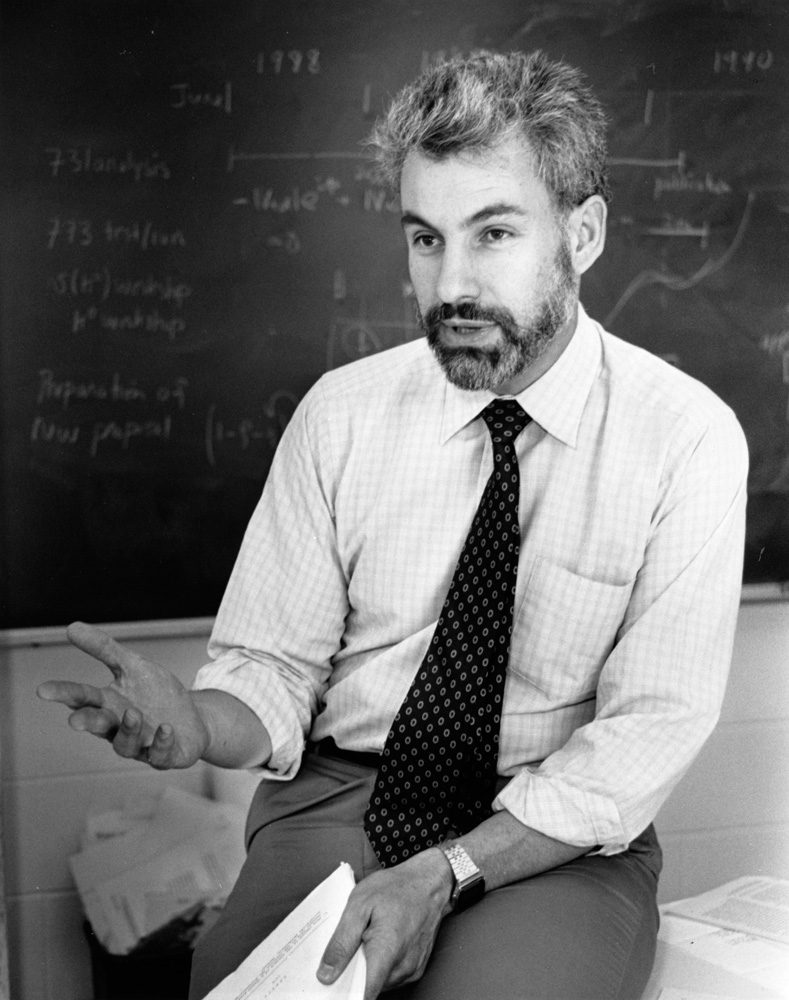

Bruce D. Winstein began his career as an experimental physicist. He became famous for making the most precise measurements of charge parity violation in the neutral K meson system. His results illuminated the tiny asymmetry between matter and antimatter that is essential for the existence of matter in the universe.
At the end of his career, Winstein became a cosmologist, focusing on the polarization of the cosmic microwave background radiation. Learn about the life story of Marc Aaronson, the astronaut who determined the age of the Universe. Find out more on i-los-angeles.
Biography
Bruce was born in LA to Saul and Sylvia Winstein. His father was a prominent chemist who was elected to the National Academy of Sciences (NAS) in 1955 and a professor at the University of California, Los Angeles (UCLA) from 1941 until his death in 1969. Bruce attended public schools in LA. He had many interests and a great curiosity about how things work in the world.
In addition to his passion for math and physics, Bruce aspired to work in theoretical physics. Following in his father’s footsteps, Bruce did his undergraduate work at UCLA. It took him one summer working in his father’s lab to discover that he was not a chemist.
He thought about dropping out of school altogether. Yet Bruce graduated from UCLA in 1965 with a bachelor’s degree in physics and mathematics. The man was accepted by both the California Institute of Technology (Caltech) and the Massachusetts Institute of Technology (MIT) for graduate school in physics. Initially, he chose MIT, but then he changed his mind at the last minute and enrolled at Caltech.

Bruce wrote his doctoral dissertation under the supervision of high-energy physics experimentalist Clem Heusch. At Caltech, Bruce also worked with other experimentalists including Charlie Prescott, Eliot Bloom, Leon Rochester and Kirk McDonald. In 1969, when Bruce was finishing his doctoral work, his father Saul died of a heart attack at the age of 57. This greatly influenced Bruce, focusing his attention on reducing life’s stresses, eating well, keeping fit (including running marathons) and, most importantly, spending time with his family.
With the exception of one-year sabbaticals at Princeton and Stanford, Bruce spent his entire academic career at the University of Chicago. There, he also met his wife, Joan Drucker Winstein, then a graduate student in Japanese. They married on February 10, 1979, and had two children. Their home in Oak Park was an audiophile’s dream, featuring Bruce’s magnificent stereo system and record collection. The basement also housed a theater system for showing feature films.
In the fall of 2007, Bruce was diagnosed with bile duct cancer. He and Joan fought the cancer for almost three and a half years, working with doctors from the University of Chicago.
On January 28, 2011, the Kavli Institute for Cosmological Physics (KICP), the Department of Physics and the Enrico Fermi Institute, three entities in Chicago that Bruce loved dearly, held a conference in honor of his retirement. More than 160 of Bruce’s friends and colleagues from around the world attended, including his sister Carolee and her astrophysicist husband Kip Thorne, his wife Joan, his son Keith, daughter Allison and Middlebury College professor Ted Perry.
Perry, a friend of Winstein’s and the Fletcher Professor of the Arts, gave a lecture on Michelangelo Antonioni’s Surrealist Impulse. Others also recalled Bruce’s scientific career, from CP violation in the K meson system to cosmology. On February 28, 2011, exactly one month after Bruce’s friends, colleagues and family saluted his scientific career achievements, he died peacefully in his sleep.

Experiments at work
After graduation, Bruce began working as a researcher at the Max Planck Institute for Physics and Astrophysics in Munich. Subsequently, in the fall of 1972, Bruce was accepted as a senior researcher in the group of Valentine Telegdi at the University of Chicago. Four years later, he entered the Chicago faculty, where he stayed for the entirety of his career. At the time, interest in neutral K mesons was still at its peak, largely because of the surprising discovery of matter-antimatter asymmetry in the decay of these particles.
The group had been conducting a series of K meson experiments at the Argonne National Laboratory’s ZGS accelerator. Shortly after Bruce’s arrival in Chicago, the group performed the last of these experiments, a precise measurement of the lifetime of the neutral K meson. They confirmed recent results that were significantly different from the previously accepted value.
During this period, Telegdi left Chicago for Zurich, and Bruce became the leader of the group. The main source of systematic uncertainty in K meson experiments was the determination of the beam flux striking the regenerator. Bruce had an ingenious idea, the double beam technique, to greatly reduce this problem. This idea proved to be important for all future experiments he conducted.
Bruce was fascinated by the problem of the violation, in particular its origin. The scientist first presented the results of the new experiment in June 1984 at the 11th International Conference on Neutrino Physics and Astrophysics in Dortmund, Germany. The new measurement had an uncertainty that was 3.5 times smaller than in previous experiments and was consistent with the absence of a direct CP violation.
A year and a half later, Bruce and his colleagues finished analyzing 20% of the sample and published their result, saying that it did not support the latest evidence of direct CP violation. This was seen as an important discrepancy that needed to be resolved, even though the difference in the results of the two experiments was less than 2 standard deviations.
For Bruce’s leadership in precise measurements of the properties of neutral K mesons, especially the discovery of direct CP violation, he received the American Physical Society Prize. The man was elected to the NAS in 1995 for his extensive research on the critical and perplexing nature of CP violation. The scientist was also elected to the American Academy of Arts and Sciences (AAAS) in 2007.

Cosmological physicist
The Enrico Fermi Institute not only provided an environment for Bruce’s work but also encouraged him to pursue other areas, including the revolutionary merging of particle physics and cosmology. While not everything about cosmology appealed to him, especially the more astronomical aspects involving telescopes and stars, the cosmic microwave background did.
In September 2001, the Center for Cosmological Physics in Chicago was born with Bruce as its director. During his four years as director, Bruce devoted all his time and energy to making the new center a success. In the 21st century, it thrives as a national cosmology center, especially in the field of CMB cosmology.

Awards and honors
B. Winstein had received many awards recognizing his contributions to science and leadership. He was awarded a Guggenheim Fellowship in 1999. In 2003, Bruce was the first to get the UCLA’s Outstanding Alumnus Award. In 2007, he was also elected to the AAAS.
In addition, Bruce had served on various panels charged with advising U.S. laboratories, the National Science Foundation and the U.S. Department of Energy, including chairing the NAS committee that reported on the state of particle physics in 1995.