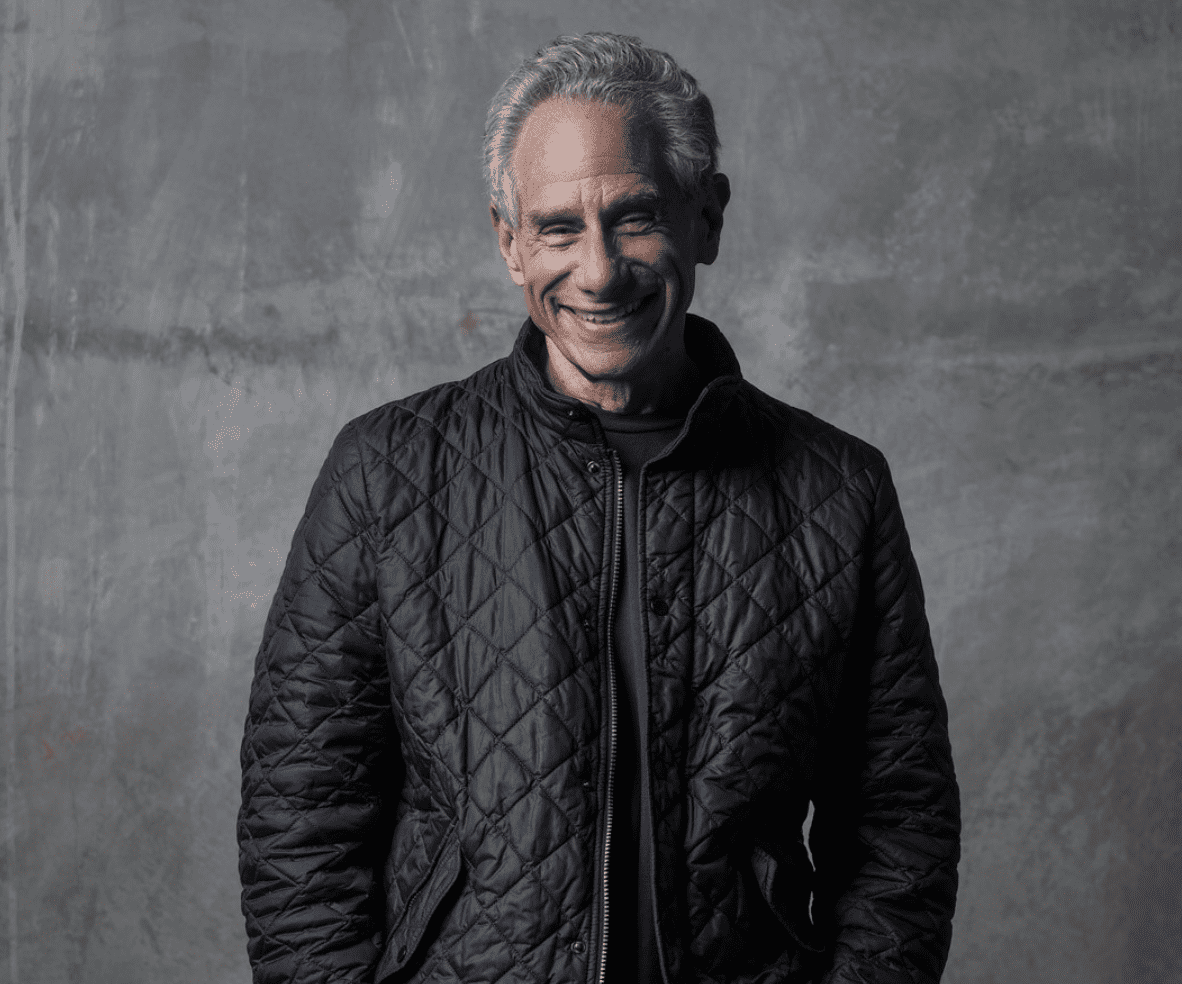

His name has become a symbol of architectural experimentation, urban renewal, and a philosophy of form that challenges conventional notions of space. This artist has created dozens of projects that have defined a new aesthetic for Southern California’s urban environment. His name is associated with architectural experiments, a philosophical approach to space, and the revitalization of urban areas through design. More at i-los-angeles.
Biography
Eric Owen Moss was born on July 25, 1943, in Los Angeles, California. After high school, he began his studies at the University of California, Los Angeles (UCLA), where he earned a Bachelor of Arts degree in 1965. His architectural education continued at the University of California, Berkeley, in the College of Environmental Design, where he received a Master of Architecture degree in 1968.
He later earned a second master’s degree from the Harvard Graduate School of Design in 1972. This extensive educational path shaped him as a thinker—an architect who views space not just as a physical category, but also a philosophical one.
Academic Career
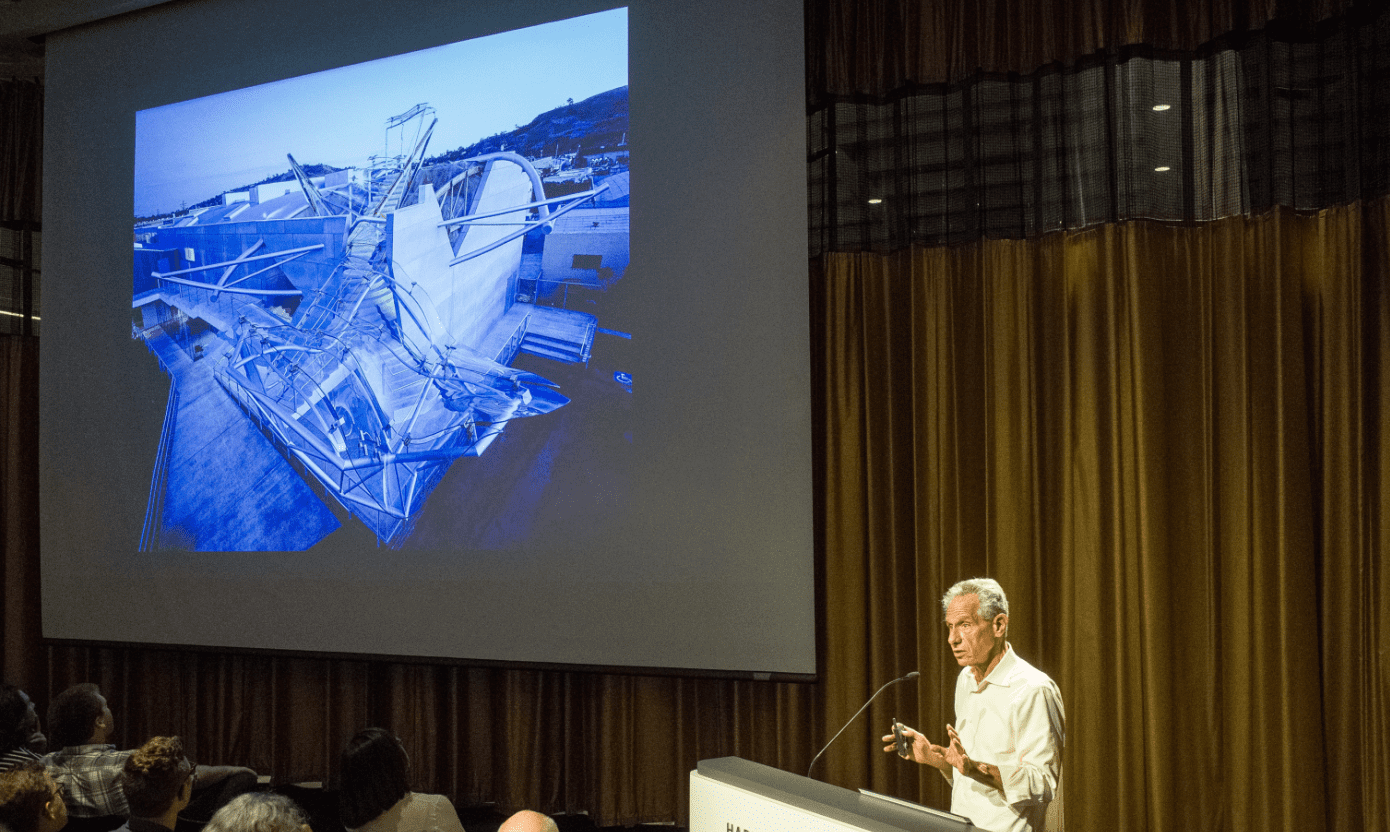
Moss is one of the most prominent architectural educators in the US. Since 1974, he has been a professor at the Southern California Institute of Architecture (SCI-Arc)—one of the world’s most progressive architectural schools—where he also served as director from 2002 to 2015.
He has also lectured and held professorships at Yale, Harvard, and Columbia universities, as well as the University of Applied Arts in Vienna and the Royal Danish Academy of Fine Arts in Copenhagen. His academic style is known for its philosophical depth: he views architecture as a “language of complexity,” where each project is a way of understanding time, material, and the city.
Architectural Career
In 1973, Eric Moss founded his own practice, Eric Owen Moss Architects (EOMA), in Culver City, Los Angeles. The firm, which employs about 25 professionals, quickly became known for its bold experiments with form and structure.
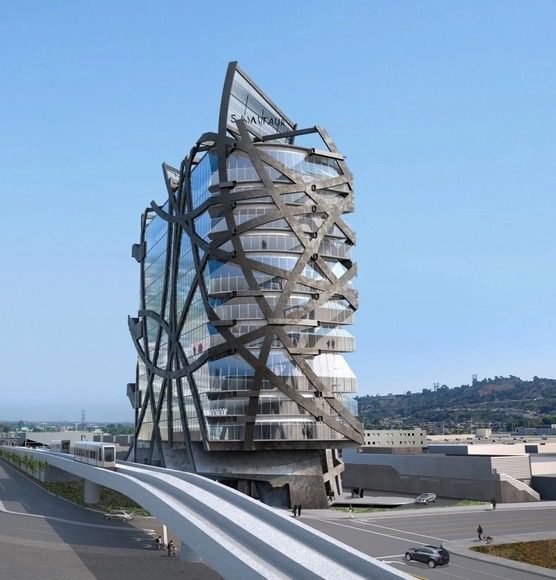
EOMA’s most famous project is the urban transformation of the Hayden Tract area in Culver City. In collaboration with developers Frederick and Laurie Samitaur Smith, Moss transformed a neglected industrial zone into a campus for creative companies, attracting firms from the design, film, internet, and digital media industries. Gradually, building by building, Moss achieved what none of his colleagues had: he created a genuine urban transformation through architecture. The Pittard Sullivan building in Culver City combines the old brick walls and wooden trusses of a former factory. A living dialogue takes place between the old and the new: a tilted cylinder serves as a grand atrium, and an angled cube functions as a conference room on the second floor. Another example is the Gary Group headquarters, where Moss cut into concrete warehouses, inserted offices, and added striking skylights, chains, wheels, Plexiglas panels, and sloping walls.
A key characteristic of Moss is his focus not just on the result, but on the construction process itself. The architect pays special attention to the dynamics of creation—from idea to material realization. His essays on architectural theory are collected in “Gnostic Architecture” (1999) and “Who Says What Architecture Is” (2007), where Moss explores architecture as a mode of thinking that constantly changes and responds to the modern world. Eric Moss’s architecture often transcends the functional. It is expressive, bold, sometimes paradoxical, but always full of meaning. Moss sees architecture as an open system of dialogue between form, context, and person. His projects are always provocative—they force you to think, ask questions, and doubt. His work teaches us to see the city not as a fixed structure, but as a process—an ever-changing language in which the architect is just one of the interlocutors. Moss does not believe in fixed rules or methods. In his book “Gnostic Architecture,” he wrote that architecture is not a belief in movement, method, or technology. It is a strategy that keeps architecture in a state of constant motion. His works are a protest against stagnation and repetition. These buildings display a practical roughness and a refined imperfection—features that have become Moss’s signature.
His most famous works include:
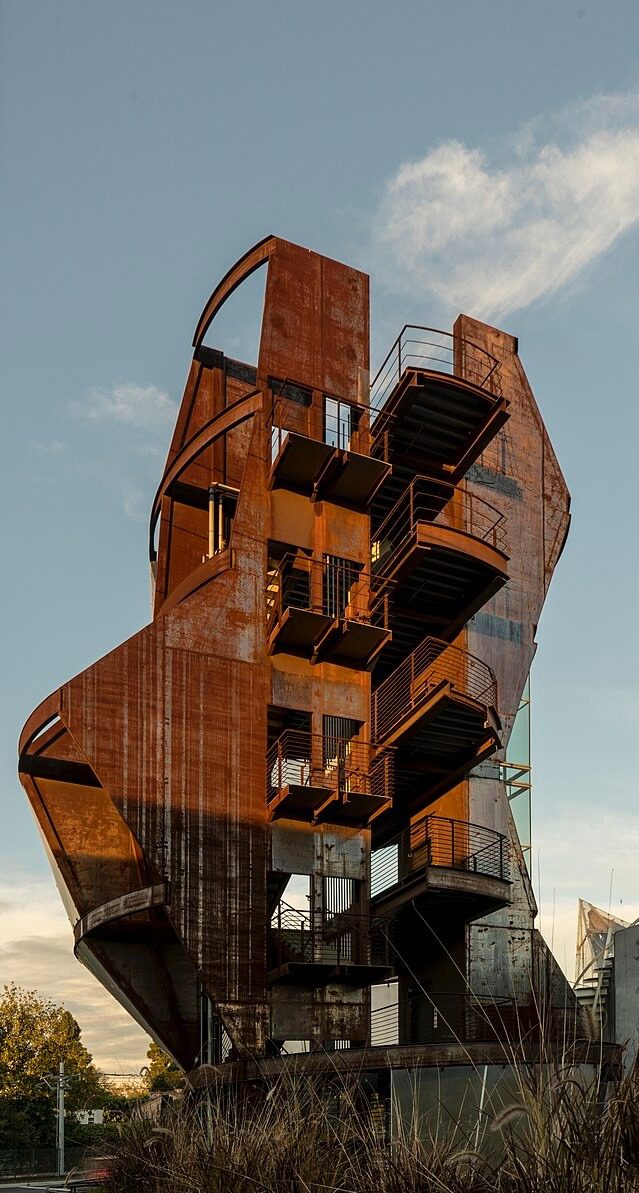
- Samitaur Tower — an observation tower that became a symbol of the Hayden Tract’s renewal.
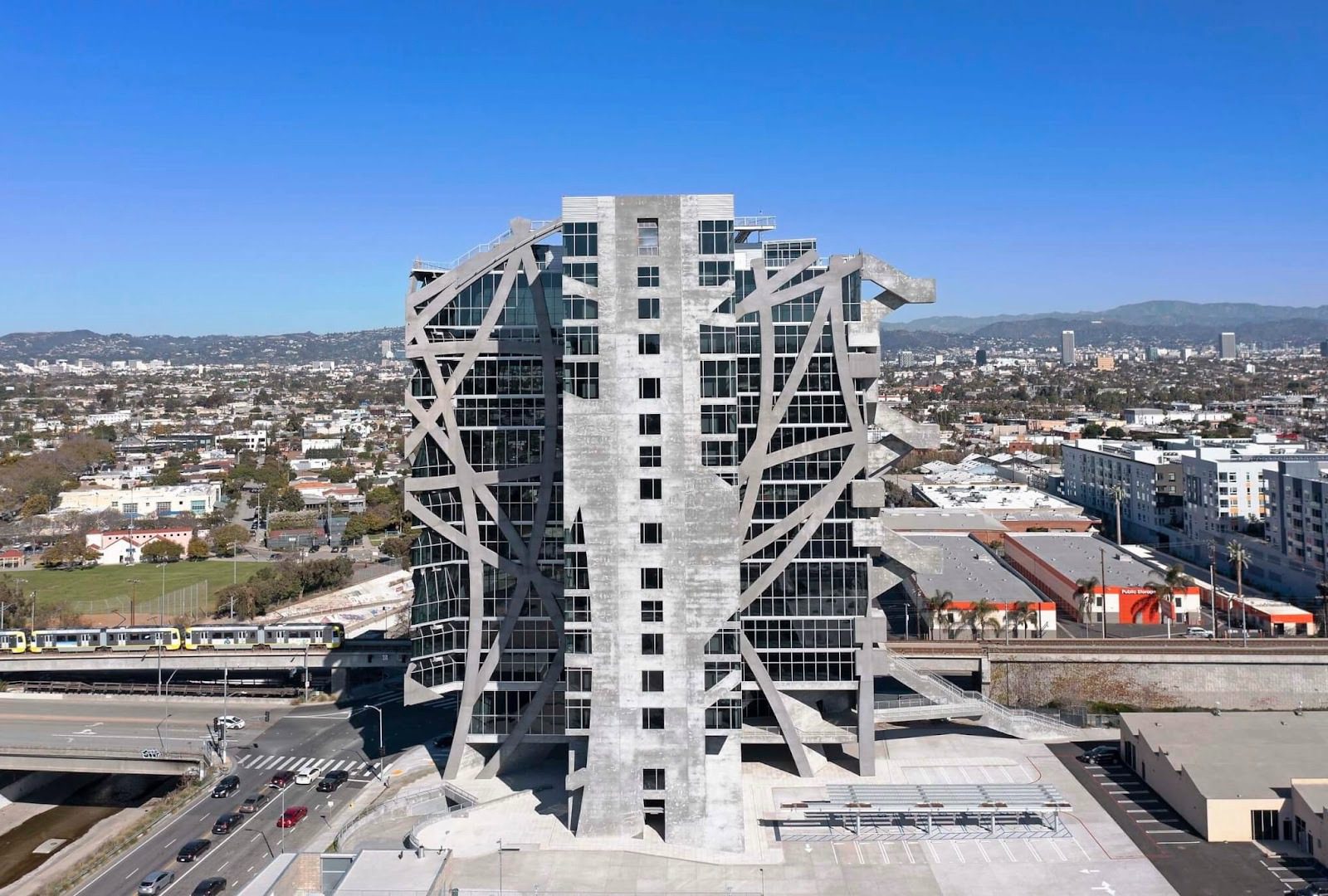
- (W)rapper — an office building with a unique external structural frame that defies gravity.
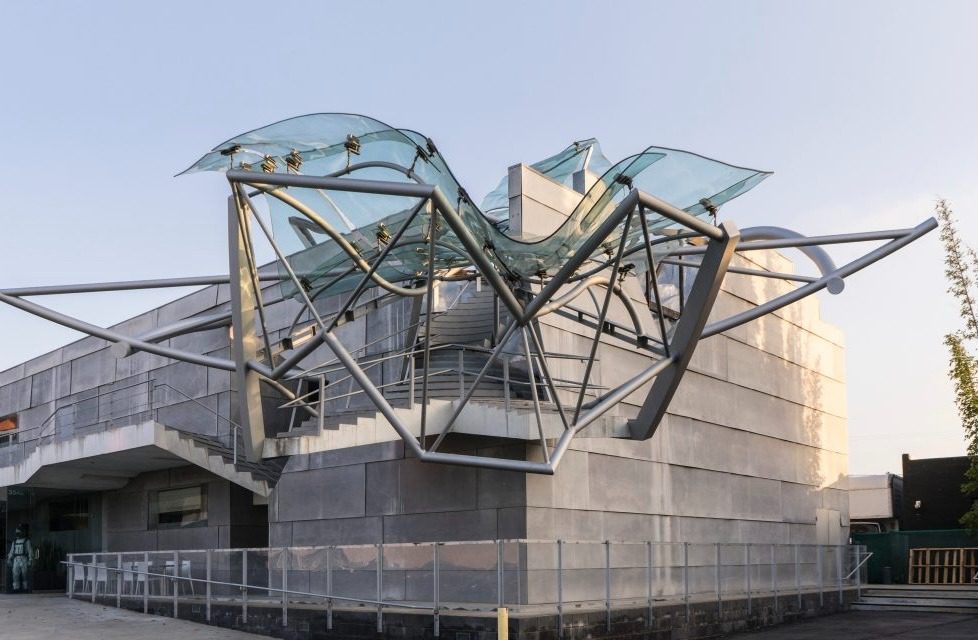
- Umbrella — a spatial experiment with form that transforms an industrial building into an architectural art object.
- Stealth — a building that received the Business Week/Architectural Record Award.
- Vespertine — an architectural-gastronomic project created in collaboration with chef Jordan Kahn. In 2018, Time magazine included Vespertine in its list of the “World’s Greatest Places.”
Moss has also worked on projects outside the US, including:
- Gasometer D-1 (Vienna, Austria, 1995, unbuilt);
- Guangdong Provincial Museum (China, 2004);
- Republic Square (Almaty, Kazakhstan, 2006);
- Austrian Pavilion (Venice, Italy, 2010).
Awards and Recognition
Throughout his career, Eric Moss has received numerous prestigious awards:
- Academy Award in Architecture (1999) from the American Academy of Arts and Letters;
- AIA/LA Gold Medal (2001);
- Business Week/Architectural Record Award (2003);
- Arnold Brunner Memorial Prize (2007);
- Jencks Award (2011) — for his contribution to architectural theory and practice from the Royal Institute of British Architects (RIBA);
- Austrian Decoration for Science and Art (2016);
- American Prize for Architecture (2020) — also known as the Louis H. Sullivan Award, for a new direction in contemporary American architecture;
- AIA Twenty-Five Year Award (2020) — for a project that has proven its architectural significance for over 25 years.
Eric Moss not only designs but also deeply reflects on his own work. His book series, “Eric Owen Moss: Buildings and Projects,” combines essays on architecture with a visual history of his projects. Critic D. P. Doordan, in the journal “Choice,” called the series “one of the best works on contemporary radical architecture.” He noted that Moss “succeeds in conveying complex ideas simply and vividly.” Throughout the book, the existential dilemmas of our time resonate—the loss of certainty, the death of religion, the impossibility of universal truth. In his book “The New City: I’ll See It When I Believe It” (2016), the architect describes how he re-envisioned over fifty old buildings, transforming a derelict industrial zone into an energetic hub for creative industries and new media. His architectural language is a combination of rough industrial texture with an intellectual approach to space. Each building in the Hayden Tract is not just an office, but an architectural statement—a dialogue between the past and the future.
Eric Moss is not just an architect but a thinker who uses concrete, glass, and steel to create philosophical texts in space. His projects are living organisms that breathe the city’s energy, defy symmetry, and seek harmony in chaos. From Los Angeles to Vienna, from Venice to Almaty, his architecture remains a voice of courage, intellect, and creative freedom—values without which the modern city is unimaginable.